Showing posts with label young adult. Show all posts

Thursday, March 13, 2014

REVIEW: One Man Guy by Michael Barakiva

One Man Guy One Man Guy by Michael Barakiva
My rating: 4 of 5 stars

I picked this book up because the book description promised humor and romance, and I love humor and romance. Not to mention the book cover was cheery yellow. Sure enough, the book was accurate as advertised.

I had worried how the theme of homophobia would be presented because I didn't want Alek and Ethan to get hurt. I didn't want to read something sad especially when the book promised humor. I still recall the disappointment of How to Repair a Mechanical Heart. Thankfully, the theme of acceptance put my worries to rest.

+ the characters

As I followed Alek's narration, I couldn't help but think about my teenage years. Alek made several bad decisions such as cutting class and lying to his parents. However, I found it pretty hard to condemn him for his decisions because it would be the pot calling the kettle black. As I judged Alek, I also judged myself. I cringed as my memories threw out all the stupid things I did on the front stage of my mind. I know one does not need the moral high ground to point out something that is outright stupid, but I still cringed regardless.

I had little problem judging Ethan, though. Heh. While most of the blame is upon Alek, Ethan was no innocent. Ethan was awesome for saving Alek from a bully, but it didn't change the fact that he was a bad boy cliche. He was part of a clique called D.O., which is short for Drop Outs and self-explanatory. The D.O. were the last classmates Alek should be hanging out with. If Alek wasn't easily influenced I wouldn't have cared, but he was. Ethan led Alek on the same prospectless path. I liked that Ethan was broadening Alek's world horizon, but they could have done it without delinquency.

Finally, Ethan wasn't sensitive to Alek's needs, which I found highly ironic. Ethan was making the same mistake with Alek as his selfish ex-boyfriend made with him. I didn't care for Ethan for most of the book, but in the end he won my heart as he won Alek's.

Alek and Ethan were flawed enough to be believable, but smart enough to realize their mistakes so the story was not frustrating to read. I liked that they were portrayed as teenagers who made stupid mistakes and not stupid teenagers being stupid.

Honorable mention is Becky, Alek's best friend. I saw the misunderstanding with her a mile away. I'm glad it was quickly fixed. I was relieved she stayed a true friend and supported Alek throughout the book. I loved how bluntly she pointed out that Alek had a crush on Ethan immediately after Alek told her about his new friendship with Ethan. It was funny how Alek could be so oblivious about himself and other people.

+ the plot

In the beginning, Alek's Armenian heritage was the source of his teenage drama. Alek's family was high-maintenance, and they had high expectations for their children, Alek and his big brother Nik. But later Alek came to realize that as much as the heritage was a pain in the neck for him, it was an important part of his identity and pride. Because of Alek, I learned a bunch about the Armenian history, culture, and food — especially the food. Warning: do not read this book on an empty stomach.

The romance was slow and nice for one that had several red flags because Alek made bad decisions. The ending was a HEA, which pleasantly surprised me. The most I expected was an Okay For Now ending, not even a Happy For Now ending, because it is a Young Adult contemporary. It was a little unbelievable how quickly some of the characters reconciled, but I confess I didn't care.

The one thing that book dropped the ball on was the bullying. It was unbelievable that Alek and the bully were on good term after the incident. But based on the many things the book could have dropped the ball on and the overwhelming theme of reconciliation, I let it slide.

Conclusion

I rate One Man Guy 4-stars for I really liked it. I bumped the book up a star because it left a big grin on my face at the end, unlike How to Repair a Mechanical Heart.

For a book that simply promised humor and romance, it delivered a lot more than humor and romance. There were themes of family, friendship, acceptance, and reconciliation to list a few. And then there was the HEA, which was icing on the cake. I can totally imagine the book as a romantic comedy movie.


Book Description

Alek Khederian should have guessed something was wrong when his parents took him to a restaurant. Everyone knows that Armenians never eat out. Why bother, when their home cooking is far superior to anything "these Americans" could come up with? Between bouts of interrogating the waitress and criticizing the menu, Alek’s parents announce that he’ll be attending summer school in order to bring up his grades. Alek is sure this experience will be the perfect hellish end to his hellish freshmen year of high school. He never could’ve predicted that he’d meet someone like Ethan.

Ethan is everything Alek wishes he were: confident, free-spirited, and irreverent. When Ethan gets Alek to cut school and go to a Rufus Wainwright concert in New York City’s Central Park, Alek embarks on his first adventure outside the confines of his suburban New Jersey existence. He can’t believe a guy this cool wants to be his friend. And before long, it seems like Ethan wants to be more than friends. Alek has never thought about having a boyfriend—he’s barely ever had a girlfriend—but maybe it’s time to think again.

Michael Barakiva's One Man Guy is a romantic, moving, laugh-out-loud-funny story about what happens when one person cracks open your world and helps you see everything—and, most of all, yourself—like you never have before.

Goodreads | Amazon
read more ››

Tuesday, February 25, 2014

REVIEW: The Pirate's Wish by Cassandra Rose Clarke

The Pirate's Wish (The Assassin's Curse, #2) The Pirate's Wish by Cassandra Rose Clarke
My rating: 2 of 5 stars

CAUTION: spoilers

Book 2 wasn’t as bad as I thought it would be after reading a negative review. Make no mistake. The book was bad, but it was not insufferably bad. I credit my endurance to my love of manga.

+ the characters

Ananna was a complete brat. I went from liking her in book 1 to hating her in book 2 in one second. She showed no appreciation for the food Naji brought to her, the concern he showed for her, or protection he provided for her. She whined about everything. She threw a tantrum virtually in every chapter.

Hell, immediately in the beginning the reader could see how cold hearted she was when she showed no grief over Eirnin’s death, the wizard who was helping her survive on the deadly island. The wizard may have been amoral and catfighting with her love interest, but he was nice enough to overlook Naji with and help Ananna regardless. All that goodwill, and not a fucking shred of grief. She even went on to befriend Eirnin’s killer. I wanted to push the brat off a cliff.

I was shocked how quickly and how well Ananna and Eirnin’s killer got along. Not only did the killer kill Eirnin, she was also a man-eating beast. Or perhaps it said a lot that only someone like Ananna could be friends with a man-eating beast. As they say, birds of a feather flock together.

The only reason I could tolerate Ananna was because she was a classic tsundere. Tsundere is a common trope in manga, especially in the harem type. When one reads as much manga as I do, one inevitably builds tolerance for tsunderes. It’s either that or give up manga altogether (not a chance in hell).

Naji was the most pitiful character in the story, never mind that he was an assassin with rare, powerful blood magic. Afflicted with a curse, abused by Ananna, stuck on a godforsaken island, bedeviled by supernaturals from another dimension, enslaved eternally to an order of assassins, ostracized because of his scary magic. Could his life be more miserable?

I totally understood why Naji was always stoic. How else could he survive? I hated how he never got compensated for his suffering. Talk about no good deed goes unpunished.

some supporting characters: For a man-eating beast, Ongraygeeomryn the manticore was surprisingly high maintenance and funny. She turned out to be pretty nice. She was nicer than Ananna. Go figure.

Pirate captain Marjani and Queen Saida were wonderful. They were women of authority, queer, and in a happily renewed relationship. The book won points for feminism, diversity, and a healthy romance. Though they were only supporting characters, the pair balanced out the emotional heroine (to put it nicely) and her manly stoic love interest in terms of gender dynamics. The ladies also helped keep the angst down.

+ the plot

The plot didn’t go anywhere till the middle of the book when Ananna and her companions finally escaped the island and resumed their adventure. High points were hit and miss. For example, the scene where Marjana reunited with Saida and the one where Ananna reunited with her family both felt flat. I didn’t receive the “I love you, and I’m never letting you go out of my sight ever again.”-like reaction that I wanted.


SPOILERS.


In addition, the entire plot pivoted on dei ex machina. Apparently, one manticore is all that’s needed to conquer battleships and keep the unscrupulous in check, nevermind how outnumbered and outmatched our heroes and their very tentative allies were. The super rare starstones needed for the second impossible task to break the curse? Oh, Ananna’s family had them all along. The third and final impossible task to break the curse? Magic shamelessly pulled out of one’s ass. Even so, I didn’t give a fuck because anything that got the plot moving along and wrapping up loose ends was good apple juice. I was ready for the book to be done since chapter one.

Speaking of the ending, it stinked. Ananna and Naji finally got together only to separate because Ananna wanted to return to her pirate life and Naji had to return to slavery as an Order assassin. They said they’ll see each other again, but who the fuck are they kidding? Long distance relationships don’t work out. After all the crap they went through and what I had to put up with, the pair went back to their old lives. It rendered the series pointless.

Thankfully, the ending wasn’t as cold a slap in the face as it could have been. The relationship was abusive because of how awful Ananna was to Naji. Naji deserved better. I think the reason he came to love Ananna was because he didn’t think anyone else could love him and his life was a big pile of shit. Anyway, I found some consolation in the optimistic romance between Marjani and Saida, so it was not like I was left with completely nothing.

Conclusion

I rate The Pirate’s Wish 2-stars for it was okay. It wasn’t 1-star because I’ve read worse, and the writing was at least succinct. Thank hell the series was only a duology. If you plan to pick the series up, I strongly recommend librarying it.

Review of book 1: The Assassin's Curse

Book Description

After setting out to break the curse that binds them together, the pirate Ananna and the assassin Naji find themselves stranded on an enchanted island in the north with nothing but a sword, their wits, and the secret to breaking the curse: complete three impossible tasks. With the help of their friend Marjani and a rather unusual ally, Ananna and Naji make their way south again, seeking what seems to be beyond their reach.

Unfortunately, Naji has enemies from the shadowy world known as the Mists, and Ananna must still face the repercussions of going up against the Pirate Confederation. Together, Naji and Ananna must break the curse, escape their enemies — and come to terms with their growing romantic attraction.

Goodreads | Amazon
read more ››

Friday, February 21, 2014

REVIEW: Shanghai Sparrow by Gaie Sebold

Shanghai Sparrow Shanghai Sparrow by Gaie Sebold
My rating: 2 of 5 stars

For a historical fantasy that contain “Formidable Devices, Fay, Etheric Science, Espionage, Opium, Murder and Bartitsu” — exciting stuff, it was restrained. Blech. Fantasy is supposed to be fantastic, not restrained. I found the book lacking in many ways.

+ the characters

I liked Eveline from the start. She was clever and wisely distrustful. She didn’t let the bad guys break her composure. She didn’t need anyone to tell her how much danger she was in. She knew when she was being bullshited and knew how to bullshit back. In short, she had a functional brain, unlike the many YA main characters I have read recently (Cress, The Seers, Cold Fury, The Pirate's Wish, and Altered to name a few).

I had only one gripe with Eveline, and it’s really more of a grip with the plot than with the heroine. I didn’t expect her to succeed at every turn, but at the climax I wished she had the upper hand. I wished it was pure wit that saved the good guys, not by convenient luck and improvisation. I wanted Eveline to be the heroine in her full glory, but instead she got nudged out of the limelight.

I also liked Beth, Eveline’s friend. Usually, the geek sidekick is a guy, but it was Beth instead, and I found it very refreshing the geek sidekick was a girl for a change. Along with Madeleine, I loved how there were women scientists and how they played a big role towards the end. What I did not love were how the scientists were passive, particularly at the rising action. If Eveline was absent, Beth and Madeleine were up the creek without a paddle.

Speaking of helpless female characters, there were too many for my liking. For a book eulogizing women’s empowerment, it seemed to love the damsel in distress trope. Thankfully, the plot lines for Treadwell and Charlotte wrapped up quickly and kept the angst down.

I hated Holmforth’s viewpoint. He was a big sack of self-loathing and prejudices. Being in his head, even though it was only 3rd person, pushed my limit for the foul character. I had to skim his viewpoint to salvage my enjoyment with the book. Thankfully, his viewpoint ebbed towards the middle of the book and didn’t rise back till the rising action. Just like how the heroine was nudged out of the limelight, so too was Holmforth in his role as the main bad. As a result, his comeuppance did not feel as satisfactory as it should have been. It was more like an afterthought really.

As for Liu, I wanted to like him, but the guy was too mysterious. Mysterious Liu is mysterious. I recognized that was the intention, but it really impeded me from getting to know him. I couldn’t get any sense of him other than the fact that he wasn’t an enemy of Eveline’s. At least, not intentionally. Plus, it didn’t help that he was around Eveline’s age. I kept thinking of him as her love interest. You know you read too many YA when you automatically assign any boy whom the heroine immoderately interacts with as the heroine’s love interest. Finally, it bothered me that the one important Asian character in the entire book and he was mysterious and exoticized.

The only characters who were more mysterious than Liu were the Folks, which the book called the faeries. And they weren’t mysterious as they didn’t have any character development. Throwing out a couple ubiquitous details such as how the Folks have magic and how they’re immortal does not constitute character development. Despite what a big deal they were, the Folks were never more than hazy, shadowy background characters.

+ the plot

I hated the long ass flashback at the third of the book. Seriously, it was really long. It fucking took up 16% of the book. Yes, I counted. I liked Eveline but I did not need to learn in minute detail how she lost her bourgeois family and became a hardened street urchin. I wanted Eveline’s backstory but I did not want it in one constipated infodump of a giant sob story. No. Just no.

In regard to the setting, the sense of England was strong, but the sense of China was pitifully weak. Even though the setting alternated between England and China, it was set in England like 80-90% of the time. The few scenes that did take place in China honestly felt like they could have taken place anywhere else. The book would have been better off set entirely in England and in a Chinatown of England. “Far Eastern steampunk” my ass.

Well, at least there was steampunk because there was not much of anything else. The espionage was underwhelming. The etheric science was nebulous. The historical side was thin. It’s like expecting real fruit juice but receiving some carbonated shit made with 10% real juice. This reader was highly disappointed.

Conclusion

I rate Shanghai Sparrow 2-stars for it was okay. The book was a classic case of all that glitters was not gold. The only thing the book got right was the dynamic heroine. On the bright side, this book was still better than the Spiritwalker trilogy by Kate Elliott beginning with the fact that the book isn’t a dragged out trilogy.


Book Description

Shanghai Sparrow is a Far Eastern steampunk tale of espionage, distant empires and thrilling exploits, with a dynamic heroine.

The British Empire is at war, both within and without.

Eveline Duchen was once a country child, living a life of privilege, touched by the magic that still clings to the woods and fields of Victorian England. Now she is a street urchin in a London where brutal poverty and glittering new inventions exist side by side, living as a thief and con-artist under the wing of the formidable Ma Pether.

Caught in an act of deception, Eveline is faced with Mr Holmforth, a gentleman in the service of Her Majesty’s Government, who offers her a stark choice. Transportation, or an education – and utter commitment to Her Majesty’s Service - at Madam Cairngrim’s school for female spies. The school’s regime is harsh. Eveline has already learned harder lessons. She plans to take advantage of everything they can teach her, then go her own way.

But in the fury of the Opium Wars, the British Empire is about to make a devil’s bargain. Eveline’s choices will change the future of her world, and reveal the truth about the death of her sister Charlotte.

Shanghai Sparrow is set in an alternative England and China. It contains Formidable Devices, Fay, Etheric Science, Espionage, Opium, Murder and Bartitsu and may not be suitable for those of a delicate disposition.

Goodreads | Amazon
read more ››

Saturday, February 8, 2014

REVIEW: Cress by Marissa Meyer

Cress (Lunar Chronicles, #3) Cress by Marissa Meyer
My rating: 2 of 5 stars

I was disappointed with book 2, but I still liked the series. Cress is book 3, and yup. It’s official. The series has lost its luster for me. Scant progress. Scant character growth. Book 3 was essentially the same as book 2, more running away and hiding. Yeah, there were some plot twists here and there and a couple new characters, but our heroes were still running away and hiding, and doing a piss poor job of it.

+ the plot

The book started remarkably slowly considering what had happened at the end of book 2. I had hoped the momentum would persevere. The action didn’t pick up till almost a third into the book, and it only happened because our heroes let down their guard again for like the tenth time. The action lasted for a few chapters, ebbing back to boredom. Cress and Thorne’s plotline, the meat of the book, was minimally interesting because they did very little progressing the plot.

In sum, action scenes were far and few and frustrating. They only seemed to happen because our heroes could not for the sake of their lives maintain vigilance. How many times must they get ambushed before they learn to stick in group, always carry assload of weapons, make exit plans, and so forth?

Making matters worse, their plan to save the world was to crash Queen Levana and Emperor Kai’s wedding so Cinder could reveal the truth and demand the throne back in front of the cameras. Bitch please. Queen Levana would sooner grow a bouquet of flowers out of her asshole before she ever surrendered. I couldn’t believe this was the best our fairy tale heroes could come up with. Thankfully, Cinder reunited with Dr. Erland who told her straight up how incredibly stupid her plan was and gave her another plan.

The new plan was to go to Lunar and start a revolution. Bring the fight to the tyrant and bring the oppressed people hope and the truth to their face that their Princess Selene was still alive and fighting for them. Of course, like the unprepared dimwits our heroes were, they didn’t have any idea of how to do it. I kid you not when I say our heroes hoped luck would accomplish things for them. By the way they were constantly improvising, it was sure as fuck weren’t going to be through intelligence and strategy. About the only time our heroes knew what the fuck they were doing was at the climax, which was a merciful relief however brief it was.

+ the characters

Cinder & Kai: I thought Cinder experienced significant character growth at the end of book 2. I thought too optimistically. While it was frustrating watching her trying to control her Lunar abilities, what was really frustrating was watching how terribly she lead our heroes. As a cyborg, she has no excuse. Download some leadership guidebooks and stop operating on ignorance. She also should discard her silly fear of becoming like Queen Levana because of her powerful Lunar abilities. It’s fucking ridiculous how Cinder thought she could become anything like that tyrant. At this point, I don’t give a shit for realism and wish she would Mary Sue up.

At least Cinder and Kai are a perfect match. To say Emperor Kai is a terrible leader is to put it nicely. Dude’s an idiot, too idealistic for his own good. I still cannot get over the fact that he accepted Levana’s marriage proposal in book 2 and continued to think things will somehow work themselves out in book 3. The dude actually thought he was saving millions of lives by sacrificing his to the evil queen. On the bright side, he didn’t deny the sure-as-fuck chance the tyrant would kill him quickly after their exchange of “I do”s.

Scarlet & Wolf: Scarlet got captured and Wolf turned uselessly emo. Scarlet’s contribution in book 3 was to only introduce the reader to Winter, the next damsel in distress for book 4. Wolf’s contribution was to be a listless meatbag for Cinder to practice her Lunar mind control power over.

Cress & Thorne: These were the star couple of book 3, the eponymous damsel in distress and her dashing rogue of a spaceship captain. I liked Cress in the beginning because of how shamelessly honest she was of her role as a damsel in distress and how funny she was in assuming Thorne to be her knight in shining armor. Their romance poked fun at fairy tale tropes. However, the humor wore off quickly for me, and I became bored and impatient for Cress to toughen up.

Thorne, I liked. He was one of the very few characters who were useful. Even when he became blind, he didn’t let his handicap stopped him from kicking ass and rescuing Cress again. As silly as Cress was with her helplessness, dreams, and sob story, her romance with Thorne was still a big step up from Scarlet and Wolf’s angst-filled romance. Cress and Thorne were honest and open about their feelings, which is a lot more than I could say for the other fairy tale couples.

everyone else: I still loved Iko, Cinder’s sassy android. I eyerolled at Dr. Erland and his sob story, pardon my cold heart. I thought he could have done a lot more to help our heroes and his poor self, but mostly our heroes. Seriously, our dimwit heroes needed all the help they could get. I hated how the doctor succumbed to his regrets at the end. Queen Levana was still as wonderfully hate-able as ever. I had hoped for some character development and to learn how she became a tyrant, but didn’t get it. Oh well. Maybe in book 4.

Conclusion

I rate Cress 2-stars for it was okay. I expected too much from it, but meh. The only thing I can really say is that the book didn’t disappoint me as much as it could have, and that I haven’t lost all my excitement for the next one, unlike with the Crewel and Angelfall series.

If you loved book 1 and book 2, ignore this review and pick up book 3. You’ll likely love book 3 too.


Book Description

Rapunzel’s tower is a satellite. She can’t let down her hair—or her guard.

In this third book in Marissa Meyer's bestselling Lunar Chronicles series, Cinder and Captain Thorne are fugitives on the run, now with Scarlet and Wolf in tow. Together, they’re plotting to overthrow Queen Levana and prevent her army from invading Earth.

Their best hope lies with Cress, a girl trapped on a satellite since childhood who’s only ever had her netscreens as company. All that screen time has made Cress an excellent hacker. Unfortunately, she’s being forced to work for Queen Levana, and she’s just received orders to track down Cinder and her handsome accomplice.

When a daring rescue of Cress goes awry, the group is splintered. Cress finally has her freedom, but it comes at a higher price than she’d ever expected. Meanwhile, Queen Levana will let nothing prevent her marriage to Emperor Kai, especially the cyborg mechanic. Cress, Scarlet, and Cinder may not have signed up to save the world, but they may be the only hope the world has.

Goodreads | Amazon
read more ››

Wednesday, February 5, 2014

REVIEW: Vodnik by Bryce Moore

Vodník Vodník by Bryce Moore
My rating: 3 of 5 stars

The book was fun as expected. What attracted me was the non-American setting and an underused mythology. The book delivered Slovakia and Slavic mythology. The mythology portion consisted of a fire spirit, a water spirit, a ghost, and a grim reaper. I admit it sounds generic. But as a big reader of urban fantasy, anything that isn’t vampires and werewolves, Greek/Roman mythos, Celtic mythos, or Norse mythos is a cheery break. Unfortunately, it was a shame that the basis for the Slovakian setting was flimsy.

+ bad parenting

In the beginning of the book, I didn’t think much of Tomas’s family moving back to his mother’s homeland. They moved back because they wanted to maintain their middle class-ish lifestyle. Their money would go further in Slovakia with what little they had left after their home burned down. I was skeptical about his mom becoming a teacher (and thus, the breadwinner) and his dad becoming a writer, but I didn’t think it was particularly impractical.

But as the story unfolded and I learned more about Slovakia, I learned it was a wonderful place to visit but a horrible place to live, especially if you’re Roma, a.k.a. Gypsy. Racism ahoy. Tomas was only a quarter Roma, but he looked Roma enough to be discriminated against. Pretty much, being Roma in modern Slovakia was like being black in the civil rights years of America. Not only that, he was also rejected by the Roma because he was too foreign.

In Slovakia, there is universal healthcare, which seems good... until the reader learns bribery is a way of life. I got eye sore from eyebugging hard at Tomas when he thought going into crippling debt to get healthcare in America was on the same level as needing to bribe unreliable, untrustworthy, racist doctors to get healthcare in Slovakia. As if!

Let me put everything on the table. Tomas was an outcast in school back in America because of his scars. (I believe the isolation had to do more with his being shy, but for the sake of argument let’s take Tomas on his words.) When he moved to Slovakia, he was still an outcast. Only this time instead of just being discriminated against for his scars, he was also being discriminated against for his race by everyone, including his own race. Police treated him like a crook; who gives a fuck if he’s the one needing help, no such thing as a good Roma. The local boys bullied him; just what a shy boy could ever want, being ignored back in America was boring~♫. The doctors would have to be bribed if he get hurt; money does go further in Slovakia, physically into other people’s pocket as bribes. Tell me again why his parents wanted to move back to Slovakia.

Let’s not forget the supernatural things that wanted Tomas dead. But I don’t blame his parents for that. Everything else I do blame on his parents. Oh my gawd, these parents! I don’t doubt they love him, but I seriously question their parenting. They knew these things, but they moved back willingly anyway, and for such flimsy reasons. Had the reason been that a high-paying job forced them to, I wouldn’t have been mad as hell. This leads me to think it’s not so much a case of poor parenting as it is a case of poor writing. To be specific, a poorly thought out reason for the hero to be in Slovakia.

+ the characters

On the bright side, there was no Disappearing Parent Syndrome. Tomas’s family played a big role, especially towards the end. Tomas’s cousin Katarina was kickass despite her illness. It was nice to have strong female sidekick that wasn’t the hero’s love interest. I chuckled when Tomas learned Katarina was his cousin.

I didn’t care much for Tomas in the beginning, but that’s because I don’t care much for self-pitying heroes. There were moments when I didn’t like him, and those were when he got bullied. Logically, I knew he couldn’t fight back, but emotionally, I wished he did, logic be damned. My sense of justice demands satisfaction! It took some while but I eventually liked Tomas as he shed his shell and unleashed his inner fire (figuratively). I liked how his strength came from his self-confidence and how he work hard to build it chapter by chapter. For all the abilities he discovered he always had, they were useless to him if he didn’t have self-confidence. I liked how he overcame his fears and turned them into his source of power, literally in the supernatural sense.

As for the antagonists, the supernatural characters were too wishy-washy for my liking. It was dizzying how one moment they wanted Tomas dead and the next moment they helped him. Good grief, make up your damn mind. There’s a limit to how much a character can be trotted out as a red herring.

Conclusion

I rate Vodnik 3-stars for I like it. The book concluded satisfactorily despite a few loose ends. While it doesn’t take a lot of effort for me to imagine how those loose ends might be resolved thereafter, a second book would be a joy to have. Not only was the book fun, it was meaty. It surprisingly covered a lot of issues: social, youth, health, and family. I really wish there was a second book.


Book Description

Teacups: great for tea. Really sucky as places-to-live-out-the-rest-of-your-eternal-existence. Very little elbow room, and the internet connection is notoriously slow. Plus, they’re a real pain in the butt to get out of, especially when you’ve gone non-corporeal.
 
When Tomas was six, someone–something–tried to drown him. And burn him to a crisp. Tomas survived, but whatever was trying to kill him freaked out his parents enough to convince them to move from Slovakia to the United States. Now sixteen-year-old Tomas and his family are back in Slovakia, and that something still lurks somewhere. Nearby. Ready to drown him again and imprison his soul in a teacup.

Then there’s the fire víla, the water ghost, the pitchfork-happy city folk, and Death herself who are all after him. All this sounds a bit comical, unless the one haunted by water ghosts and fire vílas or doing time in a cramped, internet-deprived teacup is you.

If Tomas wants to survive, he’ll have to embrace the meaning behind the Slovak proverb, So smrťou ešte nik zmluvu neurobil. With Death, nobody makes a pact.

Goodreads | Amazon
read more ››

Wednesday, October 30, 2013

REVIEW: The Waking Dreamer by J.E. Alexander

The Waking Dreamer (The Waking Dreamer, #1) The Waking Dreamer by J.E. Alexander
My rating: 2 of 5 stars

Good news and bad news. The good news is that the prose wasn’t purple and the plot wasn’t a sea of surrealist drecks as the book description led me to believe. The bad news is that the hero was TSTL and the romance was insta-love. In short: it was a stereotypical YA fiction. Well, the writing is a few notches higher than average, not that it helps.

+ the hero

The story started off with a chapter that really should have been a prologue and not the first chapter. The second chapter was where the story finally began, with the hero’s 3rd person viewpoint. It began with Emmett on an impromptu road trip to Florida, across the country, to find his birth mother. He wanted answers and he wanted to escape his bleak life as an abandoned and neglected orphan. I totally get that, but what I don’t get is why of all times did he suddenly decide to do it less than two weeks before his 18th birthday. How hard it was to just wait until he turn 18 to do it then? He just took the car without his guardian’s permission for the road trip and a real plan. The budget for the trip; he thinks he budget. I think he’s deluded himself into thinking it’s a budget. Basically, it’s like he just woke up one day and out of nowhere decided to go on a self-discovery mission because gosh darn it, he just felt like it, like one would feel the urge to scratch one’s ass because it’s itchy. As I read further into the story, I found out I didn’t need to get anything. Dude was just fucking dumb as a bag of rocks. *facedesk*

Emmett never asked all the questions that he needed to ask, especially when he later found out how important he was in the world of magic. He barely asked a third of the questions in my mind that I thought he should have asked, not just for him, but also for the reader. Oh. My. Fucking. God! He wanted answers and there in front of him were people who can answer them. Why was he not asking them? ASK THEM! I understood the characters were actively on the run for their lives, but there were down times.

Worse, Emmett was never anything but a burden to the people trying to save him and save the world. The least he could have done was to ask how he could help the evil-fighting magic-users as they ran for the lives because they were outnumbered and underpowered. Hello?!!! These people are trying to save your life! Ask for a gun or some magic weapon thingy or, hell, even a fucking first-aid kit to carry. For fuck’s sake.

+ the romance

But oh no, it doesn’t stop there. The nail in the coffin was that he had to go and be infatuated with Amala. She’s attractive and kickass and he’s a teenage boy and a dude in distress; I get it. But love at first sight and jealous of Amala’s best friend, Keiran? Emmett was slowly dying of poison and needed to receive an antidote from someone who was very far away and very inconveniently available. He needed to get his fucking priorities straight.

Thankfully, it was only one-sided on his end.

+ the other characters

As for the other characters, I never connected with any of them. It was because Emmett was too self-absorbed. Since the story was told strictly in his viewpoint, there was perceptible limit to how much the reader was allowed to get to know the other characters. Not that it would have made a difference if there were other viewpoints because most of characters died as soon they were introduced. Yikes, deaths and deaths everywhere. The book really hammered the fact that things were deadly serious, that the fate of humanity was at risk... if only for the reader. The strange thing was that only a few of the characters (the good guys) were affected by the deaths; the rest were not. Hazrat and his faction didn’t seem to digest the news that their peers were dying and the world was going into the dumper. Helloooo, evil abounds. Shouldn’t some preparation for war be in order?

+ the world building

For a book packed with action, the pace was rather slow, particularly in the beginning. And the reason for that was not the occasional dream shit; it was because of the poor world building. I kept waiting to be clued in to what was going on and to learn about the world of magic. The book never went further beyond telling the reader the outline of the world building, and it was very stingy even just telling the reader of the bare basics. Bad guys there, good guys here. Here are factions of the good guys. Here is a gist of what Druids and Bards are. And... yup, that was about it. Twilight, a generic vampire and werewolf paranormal YA fiction, had more world building in half of the book than this book ever had; that’s how scant and bad this book’s world building was. Eugh.

+ the ending

The ending was cliche. I never mind the trope where the hero at the last minute oh-so-conveniently discovers his latent power as the Chosen One and unleashes it to banish evil (temporarily if it’s book 1 like this book is). In fact, it’s a guilty pleasure of mine. Nothing like an old-fashioned battle of Good versus Evil and Good prevails. However, in this book, it was vexing because of how utterly useless Emmett was for the entire book. Yeah, NOW he decide to be useful. Better late than never.

Conclusion

I rate The Waking Dreamer 2-stars for it was okay. While the hero was TSTL and the romance insta-love, I have read far worse when it comes to stereotypical YA fiction. Also, it was a fitting read to celebrate Halloween because of its horror elements. There is your silver lining.

It’s kind of a shame because the story had potential, the cover is gorgeous, and the book website is one of the best book websites I’ve seen. The efforts to make this book great were apparent. Of course, it is only book 1 so maybe things will improve. But, eh, I’m not holding my breath. Improvement rarely happens in stereotypical YA fictions.

Goodreads | Amazon
read more ››

Monday, October 28, 2013

REVIEW: Kings of Ruin by Sam Cameron

Kings of Ruin Kings of Ruin by Sam Cameron
My rating: 3 of 5 stars

Fun, lively, and exciting. This book was better than I expected, and I admit I expected very little due to my poor luck with the publisher, Bold Strokes Books, and to a string of same-old same-old Young Adult fictions with all the publishers. Is there any Young Adult fiction where saving yourself and the world doesn’t take a backseat to the Romance? Because good grief.

Control, The Waking Dreamer, The Trials of Renegade X, Tandem — desist your Romance shit. Yes, that includes the two of you books that I rated 3-stars, which means I like you. Desist. Y’all are series; you can do it, says the crazy person talking to books. Anyway.

What I Liked

+ the couple

Danny was a sensible main character. It was surprising because bad decisions haunted his past so I fully expected him to repeat them, but he didn’t. It was refreshing because, speaking as an avid reader of Young Adult fictions, I rarely come across Young Adult main characters who are sensible. I mean, holy shit. Finally, it was pleasant because it excused the matter that he was in the closet. Rural America, enough said. I loved how Danny skillfully balanced putting his life at risk to figure out what was going on (because ignorance could kill) and knowing when to back off to stay safe.

Kevin was adorably nice despite the fact that he was working that whole mysterious Bad Boy image. I was elated to see a love interest that was only a Bad Boy in appearance and not an asshole because Bad Boys in Young Adult fictions are usually assholes.

+ the romance

Infidelity is a huge pet peeve for me so when it was a bomb of surprise when I didn’t get angry at how Danny used his unwitting girlfriend to disguise as straight. Danny and Laura’s relationship was too casual for me to take it seriously. Danny was at least honest and guilty about his reason for having a girlfriend, and he treated her nicely if one put aside the using-her thing. Equally important was how respectfully the book treated her. I was very happy with how in the process for the reader to gain sympathy for Danny, Laura was never “bitchified.” Laura was a minor character and her relationship with Danny was very downplayed so it would have been easy for the book to do so. But it didn’t, and I was glad. I was free to be happy without guilt; I could ignore Danny’s relationship with Laura, which allowed me to focus on just Danny and Kevin.

Danny may have been in the closet, but his romance with Kevin wasn’t angsty. It was a little angsty in the beginning but it quickly tapered off because Danny was honest and open about his feelings and sexuality with Kevin. I liked how between the two boys there was no dilly dallying with the attraction and the clearing up of misunderstandings. “I like you but I’m in the closet.” “I like you but you appear to be straight.” Talk, talk, talk. “We now know both of us like each other.” OMG, y’all, kiss already. *squee*

+ Danny’s family and friends

Danny may have family issues but I loved how it was obvious for the reader to see beyond Danny’s biased viewpoint that his family was a loving family. His stepfather was a not jerk, and his stepsister was not a bitch. His mother was someone who did really give a shit about her son. I also like how Danny’s friend Eric was a true friend and was also a sensible person like Danny. The only I would have changed is for Danny’s stepsister to be part of the action because she seemed pretty cool, and it would have been nice to read about step-siblings fighting bad guys.

+ the plot

It was fast-paced. I couldn’t believe how quickly I went through the book. The book fully delivered on its promise of car chases and fiery explosions. I was just “Yaaaaaaay!” Homicidal alien-possessed cars, a secret government agency, a national conspiracy; what fun!

What I Didn’t Like

+ the world building

It was shoddily built. I didn’t mind how the human characters have little idea of what the aliens were, or Ruins as the aliens were called, but I did mind how the human characters poorly explained their theories of what they thought the Ruins were. Because of the book description’s failure to mention aliens, I thought they were evil spirits for the entire beginning. Then I spent the middle of the book being confused to learn that was not the case and annoyed with trying to find out what was the case. Though at the end I got a good grasp of what the Ruins were, I wish it hadn’t happened so late. I didn’t see any good reason to withhold the information considering that some of the story was told in Kevin’s viewpoint and not poor ignorant Danny’s.

What I Was Okay With

+ the ending

It was Happy For Now. The romance was unresolved among a few other things. Usually, I would file such an ending under things I didn’t like but I was okay with it, believe it or not. What helped was how Danny didn’t have to hide who he was anymore and was accepted and his family issues were resolved. The book ended on an optimistic note. I was left in a good place where I didn’t feel the urge to demand a sequel so I can get my closure yet I would be elated to read the sequel if there was one. Either way is good for me, and this rarely happens because I’m a fanatic for closure.

Conclusion

I rate Kings of Ruin 3-stars for I liked it. If you took the movie Transformers, focused it on the humans, and made the main characters two gay boys who have the hots for each other, you would get this book. Recommended for readers looking for a light drama and thriller read.

Goodreads | Amazon
read more ››

Sunday, August 11, 2013

REVIEW: Vortex by S.J. Kincaid

Vortex (Insignia, #2) Vortex by S.J. Kincaid
My rating: 2 of 5 stars

I thought after the events of book 1 Tom would learn his lessons and be cautious and prudent in book 2. Nope. *anger eye-twitch* He acted the same as before. No character growth. No lessons learned. Dude was fucking TSTL.

*flips table*

Rambling rant ahead.

+ the main character

Tom pissed off every influential and powerful person he came across. He pissed off people he needed help from, people he couldn’t afford as enemies, people who could make his life very hard for him or put an end to his life altogether. They were bad people so I understood the reasons for his flippant attitude but that was no excuse to go and shake the fucking beehive.

Tom wanted to become an Intrasolar Combatant and fight epic battles among the stars, yet every single action of his showed otherwise. Dude was unbelievably self-destructive. I would admire his courage to stand up to the bad guys and fight for his ideals and not take the dirty path to attain his dream if he wasn’t such a filthy hypocrite. I was frustrated at how Tom never considered what it really meant to be a Combatant or realized the great depth of his hypocrisy if by some godforsaken miracle he does become one. To become a Combatant meant to become a pawn of the bad guys and perpetuate the corruption, oppression, and everything that is wrong with society and the world.

For someone who helped his father swindle, no matter if their targets were bad guys, Tom had little right criticizing others for swindling themselves. Yes, those people were evil capitalists, but that just meant they were swindlers of a much higher level. The point is that Tom was no paragon of righteousness yet he acted as if he was much to my irritation. Hypocrite!

Tom knew how things worked in the dystopian world yet he bumbled along through life like he didn’t. He thought he could just head-butt his way towards his goals. He was so astoundingly bull-headed that he took the phrase “dumb as bricks” to several new levels.

Tom failed to practice vital discretion with his technopathy because if people found out about his very rare ability he would get a one-way ticket to the laboratory. He never once thought to train his ability and use it to survive and get the upper hand. For instance, if he thought to use his technopathy for espionage, many bad things could have been easily avoided. So fucking easily.

Tom acted with no consideration of the consequences whatsoever, impulsive as fuck. He ignored countless pieces of advice and warnings, common sense be damned. He was so insufferably TSTL that when one of the bad guys made good on his death threat I felt no pity. I actually felt a little joy that it happened, a little disappointed that it didn’t happen sooner, and a bit surprised and befuddled that it didn’t happen more often considering the growing number of enemies Tom made as the plot progressed.

In summary, the main character was TSTL on so many levels, levels that I have not even begun to scratch the surface of, that hardly a chapter went by where I didn’t think he was an absolute waste of space. A discussion of Tom’s personality flaws and dumbass decisions could fill up a book on its own.

+ issues with other characters

I also took issue with other characters. Of course, they were nowhere near problematic as Tom.

Elliot was one of the cyborgs and Intrasolar Combatants, and I didn’t like how he was used as a prop character. He had no purpose other than showing up very conveniently to show Tom the errors of his ways and simultaneously show the readers how dystopian and shitty the world was. Just when I thought things couldn’t get more contrived with Elliot, it did. Elliot underwent a sudden change of personality for a dramatic scene towards the end. The scene was supposed to be this gleam of light in the dark, designed to bring a sense of hope to the story so the readers would believe things could change for the better. However, all I could think of was that Elliot got infected with Tom’s TSTL-ness. Holy hell, Tom’s TSTL-ness was contagious!

Heather was another cyborg and a Combatant like Elliot, and I didn’t like how she was portrayed negatively. Heather was self-interested, self-empowered, and a sexual character, and for these qualities she was inflicted with a Madonna-whore narrative complex. As one of the prominent female characters with Wyatt and Medusa, Heather was the one with the sex appeal and sexual interests, and she alone was made out to be a bitch. Nice.

Blackburn was one of the bad guys, a mad scientist trope. I found it very odd how things between him and Tom were, for the most part, drama-less. I expected the two to duke it out after what happened in book 1. Instead, I saw Blackburn helping out Tom a few times. The fuck? It was just very inconsistent how Blackburn’s character was established from the ending scenes of book 1 where his true self was finally revealed. Vengeful. Paranoid. Has a loose screw. The guy should be trying to get Tom on a lab table to be prodded, poked, and vivisected.

Last but not least, I wish there was more nuances to the evil capitalist bad guys. Not that these characters weren’t believable, but at their very core they all seemed to blend together and the traits that make them different seemed superficial.

+ characters I liked

About the only characters I liked were Wyatt and General Marsh. I liked Wyatt because among Tom’s cyborg peers she seemed to be the only one who had any sense and who took things seriously. She was one of the few characters who would be the least likely to make a stupid mistake and get killed. Quite pitiful the cast.

I liked General Marsh because he was a dimensional character. I saw him as a good guy despite the bad things he did. I didn’t like what he did but I understood his reasons. He fully understood the dystopian world and the necessity for change, and he didn’t hesitate to get his hands dirty. Whether readers like him or hate him, at least someone was doing something to change the world, something that was actually productive. I wished the book featured more of General Marsh. His appearances were very few for someone who was an important character.

In Conclusion

I rate Vortex 2-stars for it was okay. Despite the aggravation that was Tom, the book was engaging. I liked the science fiction elements and the world building.

If you like this series, check out Psion Beta and Data Runner.

Goodreads | Amazon
read more ››

Saturday, August 10, 2013

REVIEW: The Bell Tower of St. Barnabas by Alice Keats

The Bell Tower of St. Barnabas The Bell Tower of St. Barnabas by Alice Keats
My rating: 3 of 5 stars

The book cover and description made the novella look like a typical Boys Love manga, and it really did read like one. The usual tropes were there: a school setting, an unrequited love, and at least one of the boys was handsome and had great appeal to the opposite sex, generating groupies and predictable jealousy issues. The only thing missing was the obligatory consummation scene at the end, which was a disappointment. Oh well. It didn’t affect my rating negatively.

What could have affected my rating negatively was the angst. As a hater of angst, I appreciated how the brisk pacing and viewpoint shifting kept the angst to a minimum. I liked how Caleb’s viewpoint was the dominant one but not the exclusive viewpoint. Thus, I didn’t have to deal with Caleb’s brooding for any minute longer before the desire to skim started to arise.

I really liked how both boys were friends from the start because it made the boys’ feeling very believable. There was no blemish of instant love. Caleb’s obliviousness and Gabriel’s longing feelings could have easily come off as annoying but didn’t. I liked how it didn’t take too long for them to get together, and even though a lack of communication remained I liked how they made efforts to overcome it. Caleb and Gabriel were adorable.

Also adorable were the boys’ two friends who sat with them at lunch. Jinx and Elliot were a gay couple, and they could have rivaled Caleb and Gabriel for the reader’s attention. Yet, they nicely shared the spotlight and never took it away from the book’s main couple. I loved how for all four boys the issue of being gay was largely a non-issue and that the focus was on the boys’ feelings for their lover.

I was also fond of Emmeline. She was decked in pink and sparkle and had a stubborn and airheaded demeanor like a fairy cliche. What stopped her from being a nuisance was her genuine efforts to grant the wishes of true love. Emmeline was actually quite droll.

One character that did have me concerned was the evil female cliche. In this novella, the cliche took the form of a schoolmate who did not want the boys to be together because she had a crush on one of them and wanted that boy for herself. Thankfully, at the end she turned out to be a nice girl and things resolved amicably. I did wish, however, that the conflict with her had been resolved sooner. It lasted too long for my liking.

In Conclusion

I rate The Bell Tower of St. Barnabas 3-stars for I liked it. In addition to reading like a typical Boys Love manga, the novella also read like a contemporary fairy tale. Small magic brought the two boys together but it was true love that bonded them. It was that kind of fairy tale. I liked the nice balance between angst and sweetness. The writing was kind of cheesy but jovially so. The novella was a safely enjoyable mm-romance.

Goodreads | Amazon
read more ››

Thursday, August 1, 2013

REVIEW: Surrender by Lee Nichols

Surrender  (Haunting Emma, #3) Surrender by Lee Nichols
My rating: 2 of 5 stars

Book 3 concludes the Haunting Emma series, and what a boring series it was. Truthfully, it shouldn’t have been a series at all. The story had some good things but they were very diluted by scenes that often went nowhere and conflicts that were extended way, way beyond their shelf life.

The beginning of book 3 was slow, so slow that it should have been condensed to a few chapters and started towards the middle of the book. The middle was better but useless chapters still plagued it. Consequently, I skimmed because my patience was gone. I couldn’t be bothered to wait any second longer for the characters to finally deal with Neos.

+ the characters

You would think massive time and energy would be spent in preparation for the fight against the ultimate villain of the series, but no. The characters were winging things. I was shocked and angered by how the characters failed to make defeating Neos their fucking priority. Really? A psychopath from the fucking grave was on the loose and boy troubles were their main concern? REALLY?!

The one character who showed any commitment and serious preparation to defeat Neos was Bennett, which was good... if only he wasn’t using a highly-addictive, highly-hazardous power-boosting drug to do it. *facepalm* Boy was more likely to drop dead before he could do anything.

I was vexed at how Emma ignored and enabled Bennett’s drug habit. She spent more time thinking about how she could get some decent alone time to make out with her boyfriend than she did about the fact that her boyfriend was a junkie and she should help him. I was already struggling with the fact that she picked the “bad boy” over the good boy, Simon. It was not until in the middle of the book did she finally recognize Bennett’s drug problem, but to make matters worse, she helped shit and they broke up. Stupid teenagers.

You ask where are the parents? Well, Bennett’s parents, Mr. and Mrs. Stern, kicked Bennett out of the house in the beginning of the book and were useless as could be. They were only there to look after the kids, which they did a horrible job of. Emma’s parents, while they finally came back and stayed with Emma, were almost as terrible parents as the Stern’s were. They did little parenting, and none of it showed me that the characters truly took the issues seriously. We finally get some needed parental presence in the story and it turned out to be flaccid. Four parents, all of them fucking useless!

So I put my final hope with Max, Emma’s older brother. I had hoped when he came back in the middle of the book he would finally bring Emma to proper sense and purpose but, alas, no. I foolishly thought optimistically.

+ the ending

After several listless chapters and characters, Neos finally showed up at the end. I was disappointed how it was the only the time in book 3 he showed up, how his appearance barely lasted for a few scenes, and how utterly weak his presence was compared to the previous books. It was the final showdown yet the ultimate villain got treated like an uber tired loose end.

I hurt my eyes from rolling so much from how it all depended on Emma, the special snowflake, to defeat Neos. If this book had any sense of realism, the silly girl would have been dead in the beginning... of the series.

The only solace I found with the ending was that everyone fought and survived and that the romance between Emma and Bennett, despite a few deus ex machina, resolved satisfactory. I may have been frustrated with the characters but not so much that I wanted any of them to suffer tragic fates, which is the greatest compliment I can give to them. Seriously with sincerity. I even got a little sad for the few characters who died in the previous books.

In Conclusion

I rate Surrender 2-stars for it was okay. If you plan to pick up this boring cliché trilogy, read the books back to back. This is a series where it’s hard to remain invested and remember things if you don’t. I only recommend picking up this series if your library has nothing better at the moment for you to read.

Goodreads | Amazon
read more ››

Monday, July 29, 2013

REVIEW: Stormdancer by Jay Kristoff

Stormdancer (The Lotus War, #1) Stormdancer by Jay Kristoff
My rating: 3 of 5 stars

Pre-read Reaction

I ignore blurbs because
1) most of the times I don't know anything about the endorser,
2) it's always a couple of vague adjectives pieced together saying how great the book is,
3) sometime they're taken out of context and mean the opposite,
4) sometime they're by people back-scratching each other and may not have even read the book they're endorsing, and finally
5) they ruin the pretty cover-art...assuming the book has a pretty cover-art.
In short: book blurbs are unhelpful to me. Even the professionals and commenters at the New York Times on this opinion page agree blurbs don't do anything useful for readers.

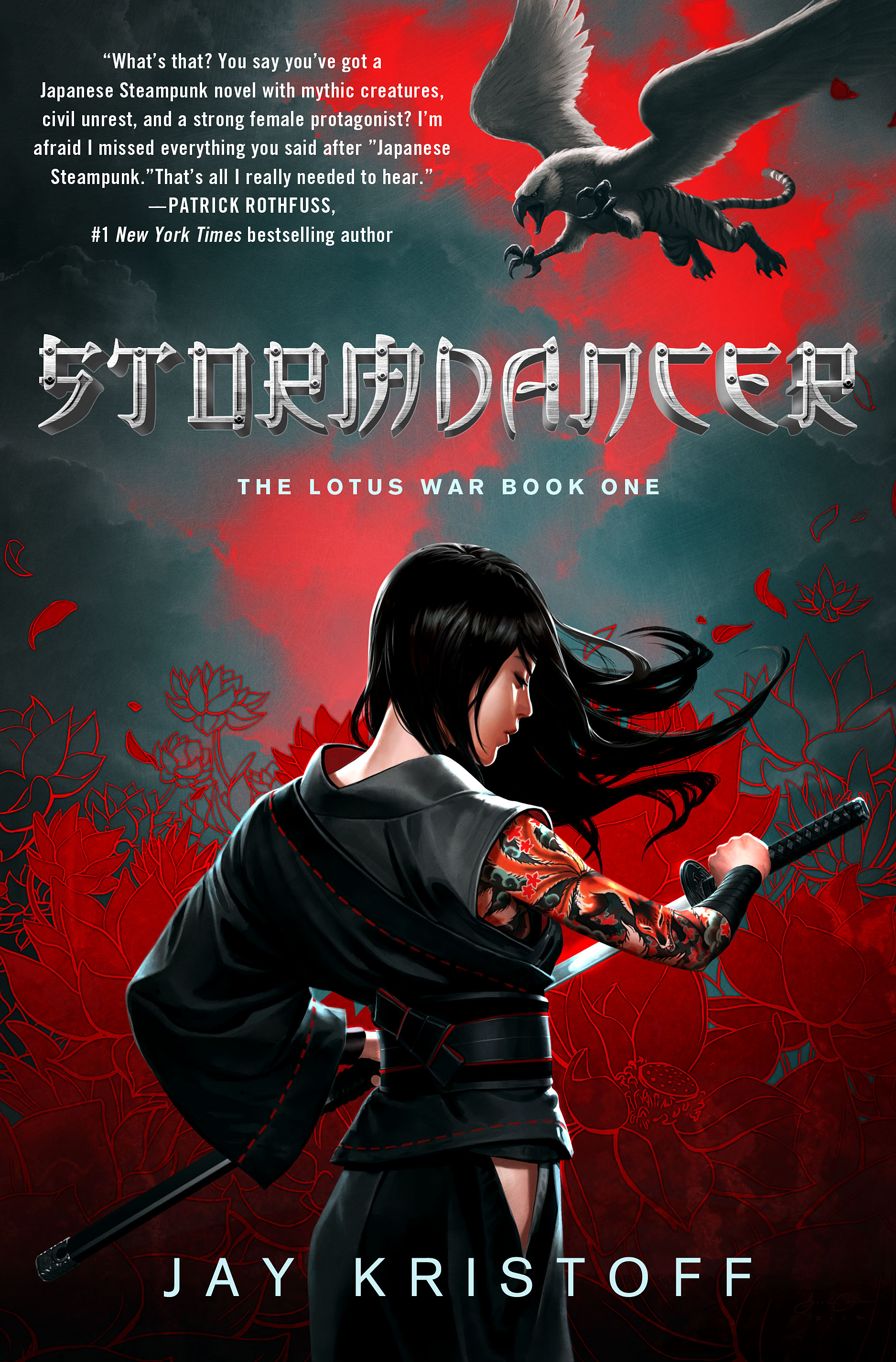
And then I saw this cover. The UK cover looks nice but, as my friend Cas said, the USA cover looks badass.

I took closer look , and this what I saw:


Japanese steampunk? JAPANESE STEAMPUNK! Why yes please. I'm all in. Now that is a blurb I could get on board with.

Moreover, I actually know this Patrick dude because I read his Kingkiller Chronicle series (tangent: find it meh but fantasy fans seem to love it).

To view the badass cover in all its glory, click here for the image alone (courtesy of TheBookSmugglers's post). In an interview with the author, Kat from CuddleBuggery book-blog reveals self-made cover mockups — hilarity ensure.

Review

I was uber excited for this book till negative reviews started coming in with horrifying criticisms of cultural appropriation. Uh oh. I stopped my happy dance of anticipation and I realized that my high expectations were too high. Red alert! Red alert! Disaster imminent. Expectations must be lowered. Expectations must be lowered.

I’m a nitpicky reader so high expectations spell certain doom for any book. Thus, I put off reading the book. Almost a year after its publication, in a fit of boredom, I finally read it.... And it wasn’t as bad as I thought, thankfully. It wasn’t good as I first hoped but it wasn’t as bad as I had come to think.

First off, the misuse of Japanese elements. It was bad alright. Honorifics, as the biggest example, weren’t used properly as suffixes and weren’t even used consistently as an established social practice. I could forgive the former and chalk them up as creative liberties, if somewhat gone wrong, but I struggled to forgive the latter because it’s such an amateur mistake. I was befuddled. Following one’s own world building should not be anything but a breeze.

+ the writing

That struggle was short-lived because the poor writing was the real problem for me. The misuse of Japanese elements, as bad as it was, was a mere symptom. The writing overdid the imagery. It was too much and too detailed that my eyeballs couldn’t help but glaze over, and when I tried to focus and read word for word I forgot immediately what was said. The sentence structure tried too hard to be flowery and thus was a mess of parallelism.

The writing crammed in everything Japanese-y it could cram for tawdry display. Japanese vocabulary was thrown without great care, translating into redundancy and pretentiousness. Heaven forbid that a reader should forget for more than a few seconds that this book is a JAPANESE-inspired fantasy. JAPANESE, I say!

Beyond the Japanese elements, some of the shifts in viewpoint were superfluous and bogged the pace, which was already bogged by the excessive exposition. I wished the narrative had kept closer to the heroine’s viewpoint. My patience was at its limit so I skimmed.

Thankfully, the writing in the second half was better. So much better that the book would have been better off doing away with the first few chapters. The Japanese elements were still misused, but less so. I wasn’t as annoyed as I was in the beginning. The writing no longer made it its number one priority to inundate the reader with all things Japanese.

Exposition was finally wrestled under control, allowing the plot to sustain action. In turn, the plot made distinctive steady progress and presented the goodies. Among the goodies was a strong heroine and political intrigue. The book began to entertain me.

+ the characters

I didn’t care for Yukiko in the beginning because of her flaw of sometimes letting her mouth run away in front of people who held the power to put her to death. Her flaw put her on the road of becoming labeled as TSTL. In addition, her father issues because of a tragic family past depressed me.

I finally started to like Yukiko when disaster struck and she faced it head on. I loved how she assertively she used Buruu, a thunder griffin who could have easily torn her apart, to save her ass. I loved how well practiced she was with her power to communicate with animals and how her power wasn’t an issue she had to deal with in the sense of survival and practical purposes. Fucking rare is a YA heroine who doesn’t have a complex about her power and knows how to properly use it. I liked how she never forgot her priorities, even when she was infatuated. For a while, I feared the romance would ruin the progress she made in character growth and to be a sensible person. I was glad it didn’t.

I did wish, however, that she showed more caution. For instance, she shouldn’t have let her guard down when she and her fellow survivors found refuge in a secret village. Just the pure fact that it was a secret village was suspicious enough. Fortunately, her efforts to face and resolve her father issues and her tragic past with all the earth-shattering revelations compensated for her deficiency in caution.

I loved how the bad guys’ enemies weren’t particularly good guys and had their own selfish agenda too. There was never any glossing over the fact that they were eco-terrorists and that their methods were violent. It made the political intrigue deliciously realistic.

I really liked how comparable the characters were to real life. You got your corrupted government, your evil corporation, your revolutionaries/terrorists (depending on which side you looked from). I did not miss how Lotus was symbolism for fossil fuels and that there were environmental themes at work. Oooh. Me likee. I don’t come across many books where environmental themes are in the front, especially with steampunk as the vehicle. I think this is my first.

In Conclusion

I rate Stormdancer 3-stars for I liked it. As a Japanese-inspired fantasy, it failed. Terribly. The book cried for competent editing; Twilight was less problematic. Hard to believe that this book had two professional editors from big publishing houses. However, as an entertaining story, albeit approached with low expectations, it passed. The second half of the book miraculously rescued the story.

Strong heroine. Political intrigue. Environmental themes. Meaningful steampunk. Symbolism with real life matters. Good balance between drama and action. No derailing romance. A satisfying ending in face of the fact that it is a series. I was so entertained that I forgave the book for all its transgressions.

If you enjoyed this book, check out the Year of the Dragon series, another Japanese-inspired YA fantasy with gorgeous cover arts.

Goodreads | Amazon
read more ››

Wednesday, July 17, 2013

REVIEW: The Woken Gods by Gwenda Bond

The Woken Gods The Woken Gods by Gwenda Bond
My rating: 2 of 5 stars

Ancient gods, a secret society, and the end of the world; I expected to be wowed. I was not wowed.

The book described how bad things were (really bad) and how high the stakes were (really high) but I scarcely felt it. Despite all the danger and how any moment they could die, or at least get maimed, if they did not tread carefully, I was never scared for Kyra and her friends like I should have been.

+ the characters

The most I ever felt in the book was some sympathy for Kyra’s situation and annoyance with her father and mother (mostly with her father since it was mostly his fault) for contributing to her predicament. I understood her parents’ reasons but keeping Kyra in the dark was a giant mistake and put her in greater danger. Given her feisty attitude, her father should have known she would go rescue him come hell or high water instead of leaving town like he asked her to. While her parents didn’t make smart decisions, the silver lining was that they were present and had an important role given Young Adult fictions’ proclivity for the Disappearing Parent Syndrome.

In regard to the heroine, I didn’t really care for her. Nothing about Kyra was annoying or proclaimed her a special snowflake, but simultaneously nothing about her was remarkable. I could not decide if she was courageous or foolish, but I did like how determined and decisive she was. Other than that, the girl was bland as can be. Without her equally courageous (or foolish) friends and some luck, Kyra would have achieved very little if anything. I did not have much faith in her.

One of the few things I did like about the book was how her friends, Tam and Bree, stuck by her every step of the way as much as possible. With Tam, I loved how quickly and firmly the book resolved the issue of his failed romance with Kyra and turned their pre-plot breakup into an amicable one with no lingering feelings. I almost thought there was going to be a love triangle between Kyra, Tam, and Oz but the idea was stomped out before any stupid romantic issue could arise. Not to say the book did not have a love triangle; it just didn’t include Kyra. Thank heavens. Furthermore, the romantic interests between Oz and Kyra was low-key. So low-key I can’t firmly call it a romance, and I liked it that way because I needed Kyra and Oz to attend to priorities.

While Tam and Oz and even Justin, Oz’s friend and a secondary character, were useful, Bree was not equally so. I didn’t like how she was treated like a third wheel and at best a cheerleader for Kyra. Attempts to make her relevant and an individual fell a couple steps short of success.

However, she was nowhere near a great disappointment that was Bronson, a leader of the Society, and the gods, supernatural sovereigns the Society protect humanity against. Bronson’s motives and desperation weren’t pushed far enough to a convincing point. The gods, except for Enki and his cohort, were not as awe inspiring and terrifying as they should have been. They were GODS yet their presence was that of the ubiquitous vampires and werewolves from a typical Young Adult paranormal — ordinary.

+ the world building

Enter another issue, one with the world building. I found the world building too simple to be believable. I found it ludicrous that the fear of permanent death is what stopped the gods from ruling the world like they used to and forced them to make peace with the humans and that somehow all of the gods were in agreement. Also ludicrous was how trainees of the Society like Oz and Justin could go head to head against the gods and how relics, as powerful as the objects may be, were all that was necessary to fight them.

Immortal beings with mighty magic and centuries of experience versus mere mortals with relics that have limited functions, the book did a very poor job of persuasion that humans were a sufficient threat to the these supernatural sovereigns. If I wasn’t a staunch reader of Urban Fantasy and seen similar world buildings (e.g. the Kate Daniels series & the Iron Druid Chronicles), I wouldn’t have accepted this world building as plausible. In sum, the world building didn’t hold up to scrutiny.

I did like that the world building strayed from popular mythologies like Greek and Celtic and aimed towards more obscure ones like African (by Legba) and Sumerian (by Enki). The world building had issues but staleness wasn’t one of them.

+ the plot

The issue of plausibility also gushed into the plot. When Kyra joined the Society they never kept her under close watch and regarded her with great suspicion considering recent events where both parties knew that their interests and goals contradicted each other and oh yeah, the tiny little fact that her father betrayed them. It should have been obvious to them, especially to Bronson, that she only joined to infiltrate and betray them too. Yet I saw members of the Society telling her their secrets and hiding place of their relics as if revealing classified information was a weekly function next to Casual Friday.

The Society did not properly act like a secret society and a global NGO with rules and bureaucracy. In another example, I struggled to understand why Bronson was allowed to lead the hunt for Kyra’s father and continued to dictate the Society’s agenda when the betrayer was a member of his own family. No matter how high and influential Bronson’s position was in the Society, there was no way he could have completely avoided incrimination and political implications. The Society should have benched Bronson and conducted an internal investigation like a competent NGO. I was hard pressed to believe that this was the same organization that mightily restrained the gods from taking over the world.

Good thing the book read fast because this was not a good book to have long moments that would allow the reader to ponder and test for foundation problems.

In Conclusion

I rate The Woken Gods 2-stars for it was okay. Pros: the book read fast, avoided YA cliche, which is easier said than done, and strived for mythological freshness. Cons: the book suffered emotional impotence, mediocre characters, and plausibility issues. The book aimed for awesomeness but ended up being dismally average. That said, the book is definitely worth a read. If readers check their expectations the book can be considerably entertaining.

Goodreads | Amazon
read more ››

Monday, July 1, 2013

REVIEW: The Rithmatist by Brandon Sanderson

The Rithmatist (Rithmatist #1) The Rithmatist by Brandon Sanderson
My rating: 3 of 5 stars

Great fantasy. It was one of the best Young Adult fantasies I have read this year. Unfortunately, a couple of things kept me from rating the book as high as I would have liked.

My Dislikes

+ the world building

First, the world building could have been conveyed more clearly. At first I thought it was complete fantasy, but once I realized it was in an alternative history setting, I thought it was in England, i.e. UK. It was not until the middle of the book that I finally goddamn realized it was actually New England, i.e. America. In another instance, when our heroes had to travel outside of the Academy to investigate another kidnapping and homicide, I could not grasp the train-like transportation they took.

Also ambiguous was the political structure. I still have no idea what a knight-senator is exactly. I thought it was the equivalent of an American senator but once they started talking about the incident being a potential international issue I began to think that maybe a knight-senator was an ambassador of some sort, maybe England.

Then, there was the Rithmatic “non-religion.” The plot glossed over religious conflicts, probably because it didn't want to bog down the pacing. I was okay with that, but I was not okay with how murky the revelation of the Rithmatic secrets remained. The ritual to become a Rithmatist, talk about bizarre! I did not know what to make of it. I was also confused by how Master was God but also used in reference to the Rithmatist priests, i.e. they called the priest Master so-and-so.

On a different issue of the world building, I did not like how the bad guys were complete bad guys with no redeemable traits. For one thing, they lived there first. It was the same old issue: natives versus colonists. What the bad guys did was wrong, very wrong, human sacrifices and genocide, but I understood the reasons that drove them to an evil extreme. I wish the sides were not made out to be black and white; the human characters had their faults too.

+ the hero

Second, the hero chafed my nerves with his passion for Rithmatics. I really liked that he had great ambitions, but I did not like the methods he used to accomplish them. Joel was a poor student on a full scholarship ride in a prestigious university; the fact that he would jeopardize this huge privilege by not doing his homework, relying on exams to pass, and worst of all, intentionally failing a class just to gamble on a chance to get into a remedial Rithmatist class astounded me. Not only was it majorly reckless, it was a kick in the suspension-of-disbelief’s knee that Joel was a poor student.

I did not like how he was so into his passion that he showed little understanding for why people did not share his passion, why one in particular, Melody, would not want to be a Rithmatist, hate it in fact. He showed so little understanding of people and overall the world, that he came off as an oblivious geek stereotype.

+ the ending

Third, the biggest issue I had was with the ending because it was two steps short of satisfactory. At the last minute, the ending revealed another villain and another meter of the apocalyptic conspiracy that could have been saved for book 2. Instead, the ending cut in the celebratory mood and left a small cliffhanger. Grrr, cliffhanger; I shake my fist at you.

Not only that, the ending also highlighted a plot weak spot that started cracking in the middle of the book. Readers learn that the villains could not distinguish between a Rithmatist and a non-Rithmatist and that was why they tried to kill Joel because they thought he was one. How could people who successfully assumed the identities of the people they killed and possessed to the point no one knew they were fakes not correctly identify their enemies? Yeesh. This somewhat undermined the bad guys’ role as an infiltrator.

My Likes

+ the world building

The world building had issues but I liked how parts of it was contradictorily vivid and how overall every part brought a high level of complexity. Though it did not outright say what time period the book was set in, the social issues strongly suggested to me it was a couple years after the turn of the century. Women's rights, class struggles, racial tension; though some were more in the background than the others, the nods to the social issues delighted me. I liked how the consequences of the events our heroes were embroiled in were appropriately far-reaching.

I loved how America was made as a nation of islands. It was a very intriguing and creative concept. I liked how one of the superpowers was Jo Seun, a superpower that conquered half of the Old World, was a Korean inspiration. It was different from the usual Chinese and Japanese inspirations. Point for Asian influence and another point for a lesser-used Asian culture.

One of the best things about the book was the magic system, Rithmatics. While I thought the book explained Rithmatics well in the text, the book had illustrations to clarify any potential confusion. In addition to the in-text illustrations, a page of illustration preceded every chapter, and each page explained a concept in-depth. I loved how the book partially served as a spell book. Rithmatics was well thought out and explained. It was one of the most creative magic systems I have read.

+ the characters

I did take issue with the hero but I warmed up to him by the end. When Professor Fitch called Joel out for his act of bullying against Melody (I loved that bullying was immediately confronted), I think that was when Joel’s character growth started. In a later event, when Joel showed Melody his late father's workshop... it suddenly occurred to me that Joel's obsession for Rithmatics may have been a form of grieving. The guy was not ready to fully face the reality that his father was gone which explained his obliviousness and recklessness. No wonder he jarred in his role as a poor student because grief made him act uncharacteristically. I was happy when he finally got in touch with reality and realized that his mom was working her ass off to pay debts, his horrible-horrible mistake in risking his education, the politics of being a Rithmatist, etc.

As for the other characters, I did not take issue with any of them. Professor Fitch was pitiful but not frustratingly so. It would have been too easy for the plot to make him as one of its victims, but I was glad he was not pigeonholed into the role.

Melody, I was very amused by her melodrama; everything bad or remotely unpleasant was “tragic” with her. As Joel’s inevitable sidekick, she balanced him out with her brightness to his seriousness. Her unicorn chalkings ruled! Not only did she provide some comic relief, but she provided instances of delicious character growth, both hers and Joel’s.

In Conclusion

I rate The Rithmatist 3-stars for I liked it. I devoured the book less than a handful of hours. It was my first Fantasy by this author and I could plainly see why some readers would consider him as a master writer of Fantasy.

Buddy read and discussion with Georgina.

Goodreads | Amazon
read more ››

Friday, June 21, 2013

REVIEW: Unbreakable by Elizabeth Norris

Unbreakable (Unraveling, #2) Unbreakable by Elizabeth Norris
My rating: 2 of 5 stars

I liked book 1, but book 2, Unbreakable, not so much. The book was split into multiple parts, and I didn’t like part one because it was a slow beginning. The book could have reduced part one to a few pages and included it in part two where the plot commenced.

I liked the plot. It wasn’t stingy with the action, and the conspiracy showed good depth. Same as book 1, the plot didn’t hesitate in killing off important characters and it killed more characters than book 1 did. Yikes. Note to readers picking up the series: don’t get attached to any of the characters.

+ the heroine

What I didn’t like about the book was the heroine and the underdeveloped science fiction elements. Janelle was both a positive and negative of the book. She was a positive because she was smart and courageous. She thought carefully before she made a decision, and when dangerous things needed to be done she got them done. Need to intentionally surrender so she could get inside a prison to rescue a friend? Done. Need to kill the dudes actively shooting at our heroes? Done. Need to bring down a criminal organization whose evil ties extended to the one of the highest echelons of the government and across parallel universes? Done, done, and done.

Even so, Janelle was as much of a strong heroine as I wanted. She was negative because her narration was too preoccupied with Ben, her love interest. Ben this, Ben that. Love of her life! I understood that she severely missed Ben, but I wished she would have showed some attempt to move on with her life. She thought about him more than she thought about her friend who died in book 1 and her other friend who got kidnapped in book 2.

+ the romance

Janelle made the book too dramatic for my liking. When she finally found Ben, he was accompanied by a second Janelle who was from a parallel universe. Oy. It was one of the many hurdles that arose and made their relationship run hot and cold, all of which could be blamed on Janelle. Janelle needed to quit letting her reactions get the better of her and tidy up her feelings. Her narration was so muddled with useless emotions.

The romance was like a jelly blob covering every part of the book, weighing the book down. I was not a fan of the romance since book 1, and I came to dislike it in book 2.

+ the science fiction side

The science fiction elements weren’t as strong and coherent as they were in book 1. There just happened to be a material that made inter-universal teleportation impossible, which somehow extended to the characters who had the inherent ability to teleport unlike others who needed the gadget. Parallel Earths were brought out with no organization, with little diversity, and with great convenience. The world building went heavy handed with the apocalypse theme as if there was no peaceful parallel Earth.

If there wasn’t a token peaceful parallel Earth I would have thought practically all the Earths in the multiverse were apocalyptic. However, that peaceful parallel Earth came with its own issue. It was peaceful because it hasn’t gone through the Industrial Revolution yet. I didn’t like the close association between apocalypse and science where all the apocalyptic Earths resulted from abuse of science. In a certain angle, the book seemed to have a strong anti-science message however unintentional it might have been.

In Conclusion

I rate Unbreakable 2-stars for it was okay. If you like this science fiction series, check out the Blood of Eden series by Julie Kagawa.

Goodreads | Amazon
read more ››

Thursday, June 20, 2013

REVIEW: Boy Nobody by Allen Zadoff

Boy Nobody (Boy Nobody, #1) Boy Nobody by Allen Zadoff
My rating: 3 of 5 stars

I was dazzled. Dazzled!

+ the hero

The book was told exclusively in 1st person POV from the hero’s POV, and I loved it because watching Ben’s mind calculate as he gauged people and situations thrilled me. Ben was believable as an assassin without a trace of doubt! He was competent. He was collected. He was peerlessly cool. When unpredicted hurdles arose and things went out of control, he adjusted to the situations and moved towards his goals. Despite the great potential for Stockholm Syndrome and attempts at brainwashing, he never succumbed to blind loyalty like a fool.

The intentional lack of development of the hero’s identity didn’t bother me whereas in other books it would have. I was so engrossed with the book that only after I finished it did I realize that Ben was rarely referred to by his name, which was fake of course, and that his real name slipped by me, only with a re-read did I learn what it was. Talk about being a Boy Nobody; the book took its title to heart.

+ the plot

The writing read like liquid running through a pipe, straightforward and fast. Chapters were short and smartly divided, every scene punctual. The book was one of those books where everything seemed so simple and effortless but you know in reality it’s to the contrary.

The plot retained the complexity and the relevancy of current events like an adult thriller. There was corruption, espionage, inter- and intra-national conflicts. Just because certain groups had the same nationality and nationalism didn’t mean they had the same goals, and your worst enemies could also be your compatriots.

The plot also had romance, which I wasn’t a big fan of to be honest but mostly in principle because of how ludicrous romance in YA can be. The romance in the book was a few shades of cliché because an intriguing girl was the push the hero needed to start reaching for independence. However, I strongly appreciated that the romance tried to do something different, hence the few shades of cliché and not outright cliché. The romance did include a love triangle but it was more for the plot’s sake than for the romance’s. The second love interest never held any serious competition; all the parties involved knew what was going on, who really liked whom. Jealousy never arose as a real issue and meanness never dictated the characters’ actions. Best of all, stupidity never affected their judgement, which I loved so much that it bears repeating: stupidity never affected their judgement! The romance worked in synergy with the plot rather against it, unlike in countless YA.

And the twist! I loved that the twist wasn’t afraid to skewer the romance. The way things resolved was realistic and in accordance with a spy novel: trust no one.

+ the issues

Where I really took issue was with the world building and a secondary character who was a bad stereotype. I understood that things were supposed to be mysterious but I wished for more answers. Putting aside the hero’s lack of identity, very little was revealed about who the hero worked for or why he was kidnapped and pressed into spy service.

Howard was a nerd, an outcast, and a favorite target of bullies. I didn’t like how he came to serve as the convenient hacker for the hero towards the end. I didn’t like how being the hero’s stooge was the only role he had in the book and the only reason why he wasn’t sleeping with the fishes. I found his character development demeaning and a tad offensive.

In Conclusion

I rate Boy Nobody 3-stars for I liked it. The book had romance but this shouldn’t deter readers who prefer non-romantic YA because the book read firmly like a thriller. Readers who like Game by Barry Lyga should check out the book. Readers who didn’t like Impostor by Susanne Winnacker should also check out this book because this was the competent spy the main character should have been.

Goodreads | Amazon
read more ››